The Clown Joke
Indignity Vol. 6, No. 13

HUMOR DEP'T.
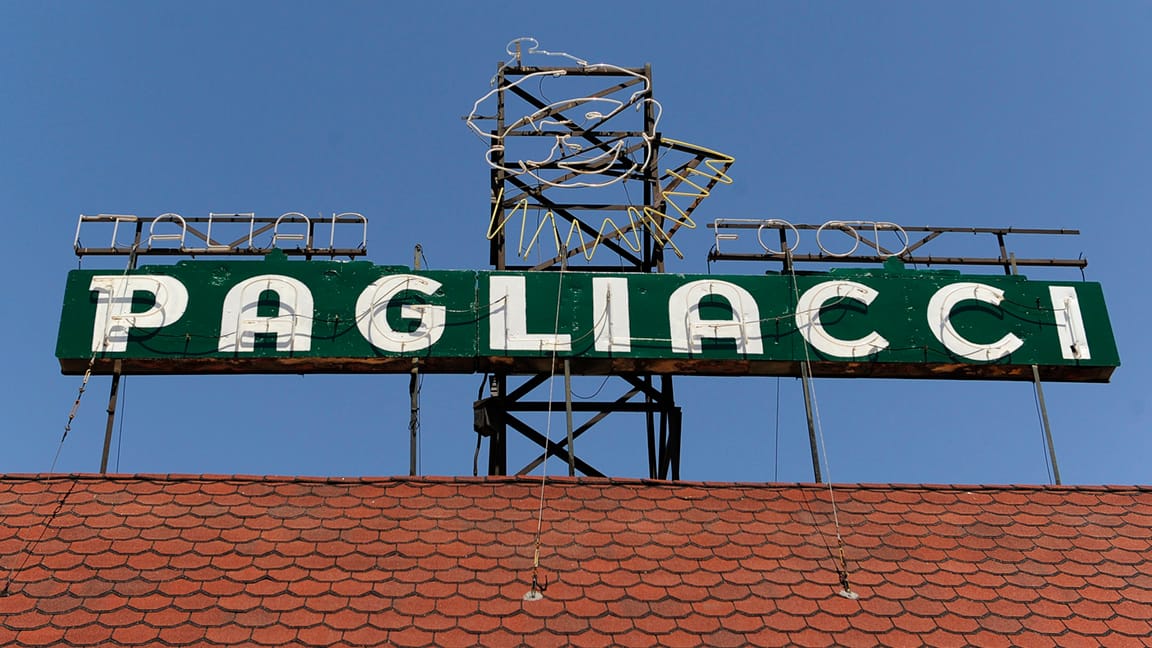
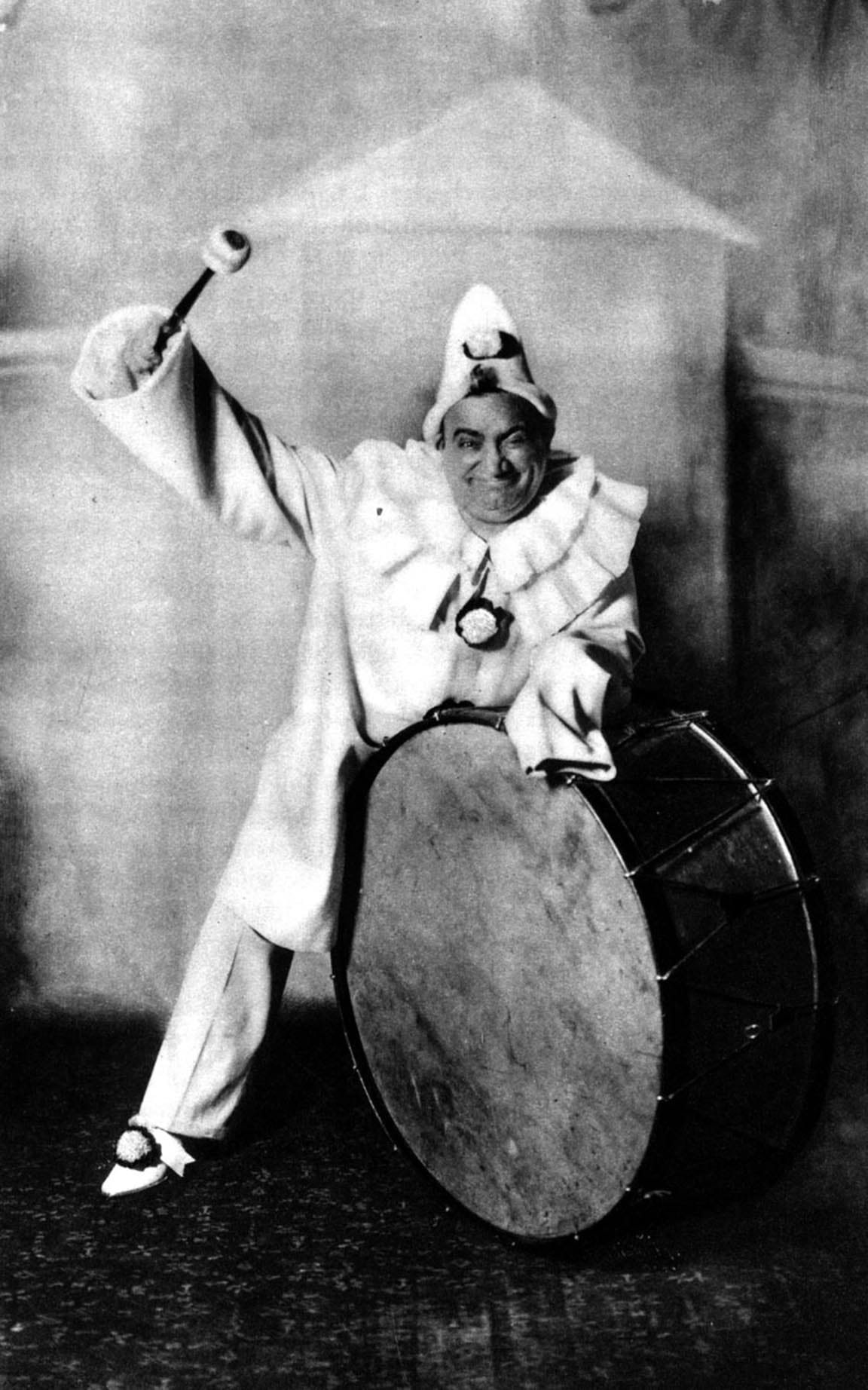
There's this guy, he's the most famous clown in the world, called the Great Pagliacci, right? So: the Great Pagliacci goes to the doctor one day. He's on the road, he just picks one out of the phone book, by some miracle the doctor has an appointment. Somebody canceled. So the Great Pagliacci goes to the doctor's office.
What can I do for you? the doctor says.
Doctor, the Great Pagliacci says, I'm feeling awful. There is no joy in my life. Everything just seems pointless and miserable. It takes me hours to even get out of bed. The sunshine feels like gloom. Food has no taste. I'm all on my own, being crushed under the weight of some immeasurable sorrow.
Ah, says the doctor, I have wonderful news. I know just the thing for you. The world-famous clown, the Great Pagliacci, is in town this very day. No one can be sad when they see the Great Pagliacci. Go see the show! Laugh! Be happy and be well!
But doctor, the Great Pagliacci says, his voice cracking with despair, I AM the Great Pagliacci.
Oh, says the doctor.
Oh, I'm so sorry, says the doctor. I had no idea—
The Great Pagliacci shakes his head. No, no, he says. He waves a hand in front of his face, up then down, spread-fingered, the gesture unavoidably eloquent. The greasepaint, he says. Without the greasepaint, it happens all the time.
Maybe not quite like this, the Great Pagliacci thinks to himself. But.
The doctor is still stammering and squirming. The Great Pagliacci gives him a magnanimous, rolling shrug, a shrug anyone could read from the furthest row of the balcony. It is nothing, he says. Forget about it. Come to the theater tonight, doctor. Bring someone. I'll leave two tickets at the box office.
The Great Pagliacci takes his leave. He goes down the stairs and out into the street, pulling his overcoat tight around him. So it goes. Still, he cannot stop pondering the doctor's words. No one can be sad. He turns it over and over in his mind as he eats a cold sandwich in his hotel room, as he tosses and turns through his appointed afternoon nap, as he rides in the hired car to the stage door. He broods on it as he dips his fingers in the pots—no one else can be trusted to do this—and paints on the famous face over his own features: the scowl, the startled brows arching up to near the hairline, the heavy smoke-blue bags under the eyes. There he is, the Great Pagliacci.
As he mounts the stage, in the dazzle of the lights, the Great Pagliacci has the sensation of floating outside himself. His body makes the usual shuffling entrance—the semblance of confusion, every muscle projecting surprise to be caught out here in the open—but his mind is soaring up and on out into the dark, among the excited murmurs already simmering into chortles and now, just like that, boiling up into guffaws.
He watches the small solitary figure on stage as ripples of delight roll outward through hundreds of souls all around. No one can be sad! The people are quaking and hooting, losing control of themselves with each perfectly timed stumble and pratfall and double-take. The Great Pagliacci! The ecstasy of the crowd is seeping into him, the admiration and—yes!—the love. Here among these strangers, in their strange city, the heart of the Great Pagliacci is wrapped in love.
But now—what is this? The hot gales of laughter are cooling. Subtly and slowly at first, they subside into a gusty, chilly breeze, fading toward the doldrums. Individual voices still let loose a "Haw! Haw!" here and there, but the sound is tight and forced. People squirm in their seats, or sit slumped and uncaring.
Horribly, the Great Pagliacci realizes: it is his own sweet taste of happiness that has soured the crowd. This happy clown is not the clown they came to see. The beatific, generous sensation sinks down into his disembodied feet and drains away. For a moment, he feels nothing but a hollow embarrassment, hanging in the dead and silent theater, as the painted form on the stage goes through the futile motions of the act.
Only for a moment does he feel that, though! In the next instant, he is flooded instead with hot sorrow and rage. The swine! The vicious, heartless, parasitic bastards! The Great Pagliacci is choking on fury and despair, helpless and utterly without hope.
A snort breaks the stillness. Not a snort of derision, but the spasm of someone shocked into laughter. And another—three more—a dozen! Alone in his pain, the Great Pagliacci hears the crowd roar back to life, like a car recovering from a flooded engine. He stomps on the gas, imagining the tachometer buried past the red line, the oil smoking away, the pistons glowing and swelling in their cylinders. Burn it, he thinks, burn it, burn those worthless shits and dump them smoldering in the junkyard.
The clown, back inside his body now, whirls in the spotlight, plants his walking stick on his own toe, and, trying to yank his foot free, kicks the cane up into his jaw. He staggers. His floppy trousers fall down to show his gaudy undershorts, and when he yanks the trousers back up, the gaudy undershorts drop down out of his ragged pants cuff. The crowd is howling, clutching their suddenly cramping bellies. Tears of hilarity pour down their bright-red faces, their twisted and blotchy faces. That deathly, awkward lull—it was part of the act! The Great Pagliacci had them right where he wanted them. Pow! Who could ever have doubted him? He IS the Great Pagliacci!

NOTHING BUT BLUE SKIES DEP'T.


EASY LISTENING DEP'T.
Here is the Indignity Morning Podcast archive!
 TOM SCOCCA

SANDWICHES CORRESPONDENCE DEP'T.
Subject: Beet and sardine sandwich from Indignity Vol. 4, No. 49
I had put some of the sandwich recipes I’d been meaning to try in a Notes file, and spotted this one. I had some beets to use up and a can of sardines in the cabinet, so Beet and Sardine Sandwich it was! Not surprisingly, a sandwich with two sardines, one beet, and some butter isn’t very filling. Surprisingly (to me at least) the beets were the more predominant flavor and the sardines faded into the background. The beets and sardines didn’t stick together well and tended to fall out of the sandwich. If I make this again I’ll try adding more sardines. That might make the filling hold together a bit better, though I’m not too optimistic. Overall impression: it’s fine. Don’t eat it if you don’t like beets.
—Laura
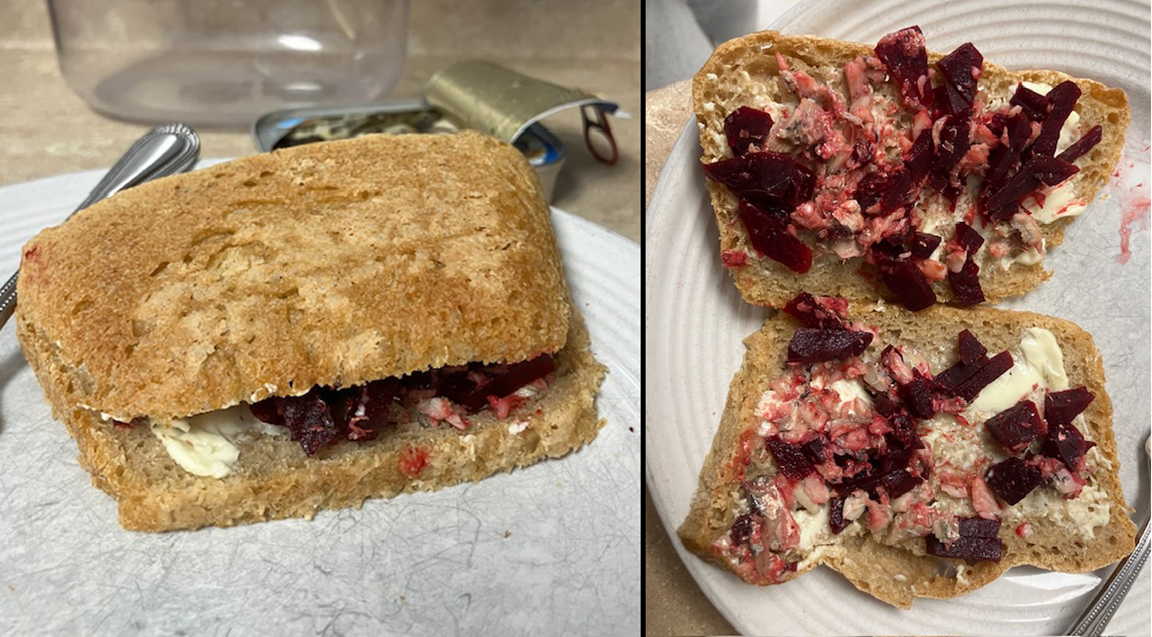
Did one of our sandwich recipes inspire? Send correspondence and images to indignity@indignity.net.

SANDWICH RECIPES DEP'T.
WE PRESENT INSTRUCTIONS for the assembly of sandwiches selected from Catering for Special Occasions, with Menus & Recipes, by Fannie Merrit Farmer, published in 1911 and available at archive.org for the delectation of all.
SEMBRICH SANDWICHES
Cut white bread in one-fourth-inch slices and spread four slices on both sides sparingly with butter, which has been worked until creamy; remaining two slices on but one side. Put between slices finely chopped cold boiled ham moistened with cream and seasoned with mustard and cayenne, and chopped nut meats moistened with mayonnaise dressing; there should be three layers of each, alternating mixtures. Repeat until a sufficient quantity is prepared. Fold in cheese-cloth, press under a weight, and keep in a cool place until serving time. Cut in one-fourth-inch slices for serving.
If you are inspired to prepare a sandwich inspired by these offerings, be sure to send your thoughts and a picture to indignity@indignity.net.

SELF-SERVING SELF-PROMOTION DEP'T.