The Stairs, Chapter 12
Indignity Vol. 6, No. 9

THE STAIRS
© Tom Scocca, 2025
This is a work of fiction. Any resemblance to actual people, places, and events is entirely coincidental, with the exception of the events in Chapters One and Two, which happened more or less as written, on the line between Cambridge and Somerville, Massachusetts, on Memorial Day weekend in 1999.
12.
Once again, we were freezing. The train platform was inside the building—the station wall arched up and turned into a ceiling and came down on the other side—but the ends were open where the tracks ran in and out, and we could see the dark blue of night beyond.
Maxine had grabbed a piece of cardboard from the hall and we'd jammed it into the space where the door met the frame, so it didn't close all the way. Between us and the main platform, where people were waiting in hats and overcoats, there was an overhead sign saying UPTOWN and a row of turnstiles, each marked 5¢. I dug in my pocket for some of the buffalo nickels.
"Can't we just use regular nickels?" Theo asked.
Maxine nodded toward a glass-and-wood booth, where a man in a deep green high-collared jacket was reading a folded-up newspaper. "We could, unless somebody noticed us again. Play it safe."
I passed out the nickels, we each dropped one into the slot on the turnstile with a clunk, and we pushed through. Light flared in the arch at the downtown end of the station—an uptown train was pulling in. The train cars were painted green, with wood paneling inside. We stepped aboard, into warm, blowing air.
About half the seats were taken. We found a spot not too close to anybody, not that any of them were paying us much attention, and sat together. All the other people seemed cold and tired and busy with their packages. The seats were made of some sort of wicker. "Where are we going?" Theo whispered.
"Uptown," Maxine said.
"Where uptown?" Theo said, getting louder.
Maxine shrugged. "We'll see what we see." She looked at her watch. "We've got a little over 90 minutes, so we'd better not ride more than 10 or 15 minutes on the train if we're going to get back."
The train started moving. We watched the platform slide by and then we were through the arch and outside, rattling on a track up above a lit-up street, between lit-up rows of buildings. Below, in the light of the storefronts, people were walking between low banks of shoveled snow. Office windows went by at our level—electric bulbs, metal desks, typewriters—and kitchen windows, and somebody's living room with an undecorated pine tree standing in it. I felt like a pigeon winging its way up the street, just high enough to be clear of the traffic and obstacles.
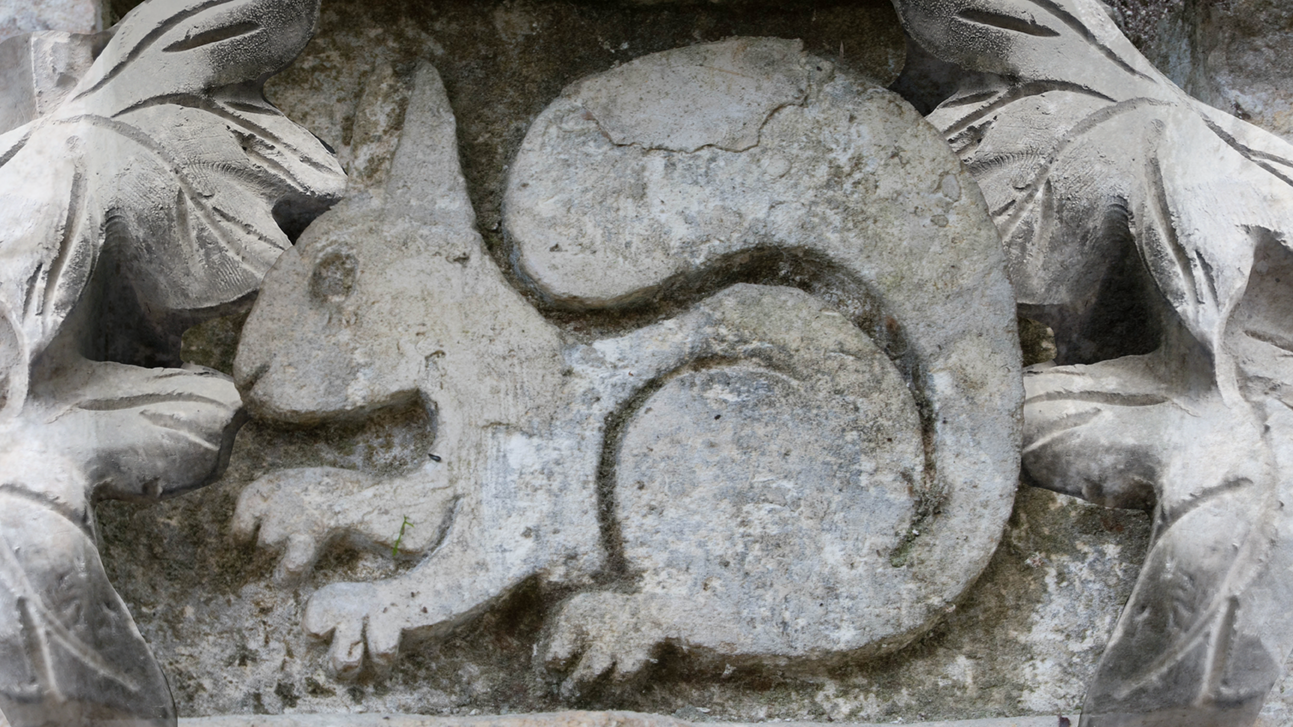
After eight or 10 blocks of flying, the train began slowing down again. Up ahead on the left was a mass of bare treetops. A platform appeared, and on the far side, in front of the trees, was an immense stone archway carved in leaves and vines. Amid the carvings were letters, reading CITY FOREST. Next to the C, between two leaves, was a carved squirrel, staring right across the platform at us.
Maxine jumped up as the train came to a halt. "Seems like this might be our stop," she said.
We squeezed by the indifferent passengers and their parcels, went down the stairs from the platform, and crossed Fishhawk Avenue to the archway. The wind coming down the street was brutal.
I'd seen before in the atlas that there was a park in upper West Marble, but I hadn't expected wilderness there. Beyond the archway was a pathway leading into the woods, shadowy even though the trees were bare. The path was loosely laid out in flagstones, indifferently cleared of snow. It wound between knobby roots, and above it branches pressed densely together. I turned and looked back across the open space of the avenue, at the train tracks and the bright buildings.
"How did they put all this forest here?" Theo asked.
"They didn't," Maxine said. "That stuff"—she jerked a thumb over her shoulder at Fishhawk Avenue—"is what got put here. City Forest is a patch of what was here before, that they skipped over while they were putting New Marble in. The College Community School will almost certainly bring us up here in the fall. They bring us up here every fall."
"So where now?" I said.
"Well." Maxine sounded less sure of herself. "Usually the school brings us in from Granite Avenue, not here." She paused. "And usually not at night."
"And usually not in 1940, in the wintertime," I said. "But if we stay here, we'll get frostbite."
"I'm going wherever those lights are," Theo said. I looked. He was right: somewhere up ahead—maybe on the path, maybe not, who could tell?—through the dark trunks and branches, a light was shining.
We walked toward it. The path was lumpy, and it bent this way and that, but it always brought itself around again in about the right direction. I kept looking behind us at the streetlights through the archway as they got farther away and more broken up by the tree limbs. I could still just make out the glow when the path squeezed between two big trees and around a third and we found ourselves standing right outside a two-story greenhouse.
Electric light and the shadows of leaves fell on the snow. Where the iron edges of the glass walls met the ground, part of the snow had melted away. The path led straight to a pair of wooden doors with iron fixtures. Next to the door was a buzzer.
"Should we ring it?" I asked.
"Depends," someone said, right behind us. "You want to gawk at the plantings, or you have some business?"
It was the same sort of thin voice we'd heard at Fort Muntjac. We spun around. A black squirrel was regarding us from a low branch a few feet away. "Marta?" I said.
"Do I look like Marta?" the squirrel said.
"Yeah," Theo said. "Don't you?"
The squirrel ignored him. "I'm Pythia," it said. "You're the ones going back and forth."
"It's nice to meet you, Pythia," I said. "We don't—"
"Your reputation precedes you," Pythia said. "What did Marta say? 'Kind of slow, but maybe not as slow as the average.' So you're on this side again. Trying to figure out what you're going to do about it."
"About what?" Maxine said.
"About the world coming to an end, I would guess," Pythia said. "You would like to do something about that, right?"
"About WHAT?" I said.
"Your friend already asked that," Pythia the squirrel said. "You're repeating yourselves. Hit the buzzer."
Theo reached up and pressed the buzzer.
Find other chapters of The Stairs here.

EASY LISTENING DEP'T.
Here is the Indignity Morning Podcast archive!
 TOM SCOCCA

SANDWICH RECIPES DEP'T.
WE PRESENT INSTRUCTIONS for the assembly of sandwiches selected from Catering for special occasions, with menus & recipes, by Fannie Merrit Farmer, published in 1911 and available at archive.org for the delectation of all.
CADILLAC CHEESE SANDWICHES
Cream one-half cup butter, add one-fourth pound Roquefort cheese, and stir until mixture is smooth; then add one-half teaspoon paprika, one teaspoon finely cut chives, and salt to taste. Moisten with two tablespoons sherry wine, spread between thin slices of bread (preferably Graham or rye), and cut into heart-shaped pieces. Arrange on a plate covered with a doiley.
If you are inspired to prepare a sandwich inspired by these offerings, be sure to send your thoughts and a picture to indignity@indignity.net.

SELF-SERVING SELF-PROMOTION DEP'T.