The Stairs, Chapter 13
Indignity Vol. 6, No. 12

THE STAIRS
© Tom Scocca, 2025
This is a work of fiction. Any resemblance to actual people, places, and events is entirely coincidental, with the exception of the events in Chapters One and Two, which happened more or less as written, on the line between Cambridge and Somerville, Massachusetts, on Memorial Day weekend in 1999.
13.
The greenhouse door opened and there, blinking into the night, was a woman about as old as Mom, wearing a white lab coat. "It's past visiting hours, I'm afraid," she said.
"They're with me," Pythia said, from down by our feet.
The woman looked down. "Oh," she said. "Have you been out...meeting people?"
"Don't fret, Doc," the squirrel said. "Discretion remains our watchword. These three already know. The important part, anyway."
"We don't know anything!" I said. "We have no idea what's going on!"
Maxine shot me a disapproving look. I shot one back at her. Who were we going to kid? We'd eaten the best and cheapest pie we'd ever seen and we'd met a talking squirrel—now two talking squirrels—and it didn't seem like there was much point in pretending we knew what we were doing beyond that.
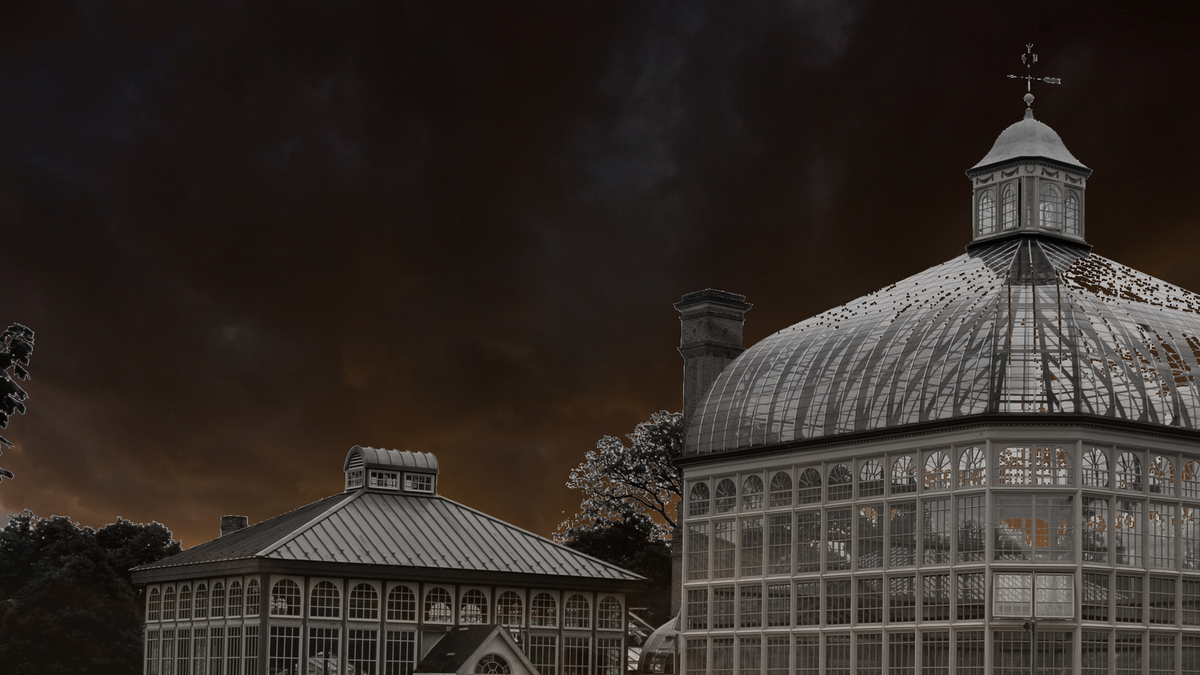
The woman in the lab coat looked us over. "Come in," she said. "I'm Dr. Opal Argemend. This is the Natural History Research Institute." We followed her through the entry, under a door-sized canvas flap, and into the greenhouse.
It was warm—not suffocating and tropical, but warm and damp like a nice spring day. Medium-sized trees loomed above us, their shiny leaves reaching up toward the ceiling. Water was gurgling along a little waterway beside flowering shrubs. The smell was like a combination of newly dug soil and a rain-wet lawn and cookies baking, and as we passed individual plants in bloom I caught whiffs of mint or sugar candy or something skunky.
Dr. Opal Argemend led us to where the plank walkway widened into a patch of floor, with a desk and some cabinets and workbenches on it. There were tall chairs with low backs. She waved us to them and we sat. Pythia the squirrel scampered up onto a workbench. "Now," Dr. Argemend said, "tell me what brought you here."
"The Fishhawk Avenue Elevated brought us here," Maxine said. "Even though the Fishhawk Avenue Elevated was torn down decades before we were born."
Dr. Argemend glanced at the squirrel. The squirrel nodded at her. "I gather you have some questions," Dr. Argemend said to us. "I'll try to explain things, but in addition to the other things time is doing, time is short."
"What are the acorns for?" Theo blurted.
"The acorns? The acorns are for the squirrels," Dr. Argemend said. "That was my contribution. I suppose that's how this all got started."
She pulled open a drawer in the workbench. The inside was gleaming with more acorns. "We had tremendous success with Q. serrata in the greenhouse, and it turned out to be exactly what the squirrels needed, for our communications studies."
"Wanted," Pythia said. "Not needed. We didn't need anything."
"Wanted," Dr. Argemend agreed. "We had been working, for the War Department, on the question of just what squirrels might be trained to do. Squirrels are natural saboteurs, as you may know. Incredible ability to get into electrical and communications systems and ruin them. Just not in any sort of focused way."
"Not by your standards," Pythia said.
"Then we discovered that we had rather underestimated their potential," Dr. Argemend said.
"By 'discovered,' you mean, we told you," Pythia said.
"You mean the squirrels figured out how to talk?" Maxine said.
Pythia gave us a withering look with her big squirrel eyes.
"The squirrels—" Dr. Argemend glanced at Pythia and paused, weighing her words. "We found that the squirrels were willing to talk. But that was not the breakthrough the War Department was most interested in. It was what the squirrels had to say. We were trying to teach them sabotage on a schedule, disabling a radio transmitter within 10 minutes, that sort of thing. But they were indifferent to the clock."
Pythia shrugged. "'We'll just get it next time,' we told her."
"Eventually," Dr. Argemend said, "we realized we hadn't understood what they were talking about. 'Next time,' to the squirrels, didn't mean another attempt. It meant the same attempt. They would do it over by going back to the beginning."
"The squirrels would reverse time?" Maxine said.
Pythia gave a little snort. "You folks have a fixation on control. We're squirrels. We can't make time move. We just figure out where time isn't moving, and we go there."
"We think about it as a kind of resonance," Dr. Argemend said. "Two different time frames move in sympathy. In the right place, it's possible to move from one to the other."
"In the right small place," Pythia said. "Emphasis on small."
"Yes..." Dr. Argemend looked pained. "The War Department thought it might be possible to make those points of resonance larger, or to create new ones. New nodes of overlap. The squirrels could go back and forth and help us calibrate the connection."
"What does the War Department want with time travel?" I asked. "Do they want to bring back ray guns from the future or something?"
"We don't have ray guns," Theo said. "It's still just regular guns, mostly."
"They didn't know what they wanted exactly," Dr. Argemend said. "All they knew was that the last war was, by all accounts, nothing but a series of blunders, one pointless catastrophe after another. So the ability to go back and reenter history to undo a blunder—the War Department thought, and unfortunately still thinks, that this could solve war in the future. With enough repeated chances, they could wage war without mistakes, clean and decisive and victorious."
"And now here you are," Pythia said. "Mistakes. No offense."
"At the War Department's request," Dr. Argemend said, "one of my colleagues set out to build what he called a temporal resonator—a machine to strengthen the connections between one time and another. It appears to be working. Too well."
I felt my stomach tightening. "And now, instead of helping to make things go better, it's going to destroy the world," I said.
"Destroy the world?" Dr. Argemend looked confused.
"That's what she said," Maxine said, pointing at Pythia. "She said something was going to destroy the world."
"What I said," Pythia said, "was that it would bring the world to an end. Not destroy it. The opposite of destroying it, really, in the long view. The world would go on forever, stuck between your time and our time."
"What are we supposed to do to stop it?" Maxine said.
"To stop it, you do nothing," Pythia snorted. "I thought you wanted to keep it going."
I could see Maxine was getting mad. I was still too alarmed to be angry. "That's what we meant!" I said. "We want to stop it from stopping!"
"For that," Dr. Argemend said, "you had better talk to Norman Melk."
Find other chapters of The Stairs here.

NOTHING BUT BLUE SKIES DEP'T.

EASY LISTENING DEP'T.
Here is the Indignity Morning Podcast archive!
 TOM SCOCCA

SANDWICH RECIPES DEP'T.
WE PRESENT INSTRUCTIONS for the assembly of sandwiches selected from Catering for Special Occasions, with Menus & Recipes, by Fannie Merrit Farmer, published in 1911 and available at archive.org for the delectation of all.
LENOX SANDWICHES
Blanch and shred two ounces almonds. Cook in enough butter to prevent burning until delicately browned. Mix two tablespoons chopped pickles, one tablespoon Worcestershire Sauce, one tablespoon chutney, one-fourth teaspoon salt, and a few grains cayenne. Pour over almonds and cook two minutes, stirring constantly. Mash a cream cheese and season with salt and paprika. Spread unsweetened wafer crackers with cheese mixture, sprinkle with nuts, and put together in pairs. Pile on a plate covered with a doiley. White bread may be used in place of wafers.
If you are inspired to prepare a sandwich inspired by these offerings, be sure to send your thoughts and a picture to indignity@indignity.net.

SELF-SERVING SELF-PROMOTION DEP'T.