The Stairs, Chapter 16
Indignity Vol. 6, No. 19


THE STAIRS
© Tom Scocca, 2025
This is a work of fiction. Any resemblance to actual people, places, and events is entirely coincidental, with the exception of the events in Chapters One and Two, which happened more or less as written, on the line between Cambridge and Somerville, Massachusetts, on Memorial Day weekend in 1999.
16.
Maxine let the phone droop halfway away from her mouth and stared toward the sound. "Hello...?" she said.
"Hello?" the voice said again. I could hear a second "Hello?" coming soft and fuzzy through Maxine's phone speaker. In the dim corner, a tall, thin form slowly stood up, dark but for the yellow glow of an old flip phone in one hand.
"Am I speaking to Norman Melk?" Maxine said. The figure stepped into the sunlight coming through the window: skinny, stooped, the face lined and spotted. A thinned-out tuft of silver hair drooped toward the glasses. The eyes blinked behind their lenses in the brightness.
"Why, it's Maxine," he said, in a voice raspy with age. "Rollo. Theo. Here and now. What an absolute delight to see you." He snapped his phone shut, put it in his pocket, and smiled. He had thin old lips and long old teeth.
"I told you we should call him," Theo said.
"Uh, hi," I said. "Hello. Sir." I was still flustered by the fact that anyone else was in the room, let alone Norman Melk, let alone Norman Melk but ancient. "How did you get here?" I asked.
"Oh, I've been here all along," Norman Melk said. "Forever. We had it so much easier with the tenure track, you know. Walk through the gates of Marble College as a matriculating teenager, move right up to graduate school, and before you know it, you're a distinguished emeritus, napping in the department lounge, while your own books gather dust with the others on the shelves. It's awfully peaceful."
"You're a professor," Maxine said.
"Of course I am," Norman Melk said. "You yourself—" He paused. "Ah," he said. "Yes, no. Certainly." He pinched the bridge of his nose in thought again, like he had out on the snowy sidewalk of 1940.
"When was the last time you saw us?" Maxine said.
"Did the world get saved?" Theo said.
Norman Melk held up a hand, while the other hand kept pinching the bridge of his nose. "Not yet," he said. "I need to consider this very, very carefully."
We waited. Dust floated in the sunbeams, moving around without going anywhere in particular. Finally he unpinched his nose bridge and looked at us again. "I am sorry, children," he said. "I am very happy, extremely happy, to see you again, after such a long time. Yet I think it would be extraordinarily dangerous, right now, if we were to talk about...the problem."
"But Dr. Opal Argemend told us to talk to you about it," Theo said.
"Yes," Norman Melk said slowly, weighing each word. "She...informed me of that. Dr. Argemend is—she was—Dr. Argemend's work," he said, "belongs to the realm of nature, classically understood. It involves complex interactions and certain subtleties of the time scale, particularly where trees are concerned. But it does not dwell on problems of deeper physics or philosophy. This is why I was brought in, along with...no." He stopped again.
"What's wrong?" I asked.
"You are familiar with the phrase, 'The devil is in the details'?" Norman Melk asked. I wasn't sure Theo was, but he nodded along with the other two of us. "Well, it is particularly true of our situation," he said. "I think I may safely speak in general terms, here, about what happens when two time frames—that is, two different points of a single time frame—become entangled. In such situations, there is a real risk of conflict between the underlying realities."
We looked blank. "It is confusing," he said. "Even in principle. In practice, it is much harder. Maybe the simplest way to think about it is what's called the grandfather paradox. Suppose you were to travel back in time, and while you were there, you killed your own grandfather."
"Why would we do that? We like our grandfathers," Theo said.
Norman Melk nodded. "Let's say you did it by accident," he said. "If that happened, losing your grandfather would be the least of your concerns. For the sake of the paradox, what I mean is, imagine that you were to kill your grandfather, your father's father, before your father was ever born."
"Then we wouldn't have a grandfather or a father," I said. "So we couldn't have been born either."
Norman Melk nodded. "And..." he said.
"And," Maxine said, "if you couldn't have been born, you wouldn't exist. But if you didn't exist, you wouldn't have been able to kill your grandfather in the first place."
"It's impossible," Theo said.
"Yes," Norman Melk said. "But people have a very hard time deciding which part is the impossible part. The only way to tell would be by going back and trying to kill your grandfather and seeing what happens. There's no reason to think what would happen would be pleasant, however."
"Our grandfathers don't even live in Marble City," Theo said. "Mom's dad lives in Barnstown and Dad's dad lives in Canvale."
"It's just an example of the principle," Norman Melk said. "If anything, the example simplifies things, because you know that without a grandfather, you wouldn't exist. It's much harder to say what other results might come from other actions if you took them."
This reminded me of something we'd learned in school. It suddenly seemed more alarming than it had before. "Isn't it true that even tiny events in the world can produce huge effects later on?" I said. "Like a butterfly flapping its wings can end up causing a hurricane?"
"That is absolutely correct," Norman Melk said. "Chaos theory warns us that new conditions can spin out unimaginably from the most minor of changes. And yet, even so, if one had to choose between, say, doing something that could possibly startle a butterfly, or doing nothing while someone else goes ahead and deploys a temporal resonator—well, either set of consequences would be unforeseeable, technically speaking. But you would probably take your chances with the butterfly."
"What do we do, then, to do that?" Maxine asked.
Norman Melk held up his hand again. "As I said, this situation is a very tricky one. We are heading toward this difficulty, you and I, in opposite directions. The events I may see in my past—this whole business of the acorns, the squirrels, the temporal resonator—are still in your future. If I were to tell you about them now, with my memory moving backward and your plans moving forward, our experiences could collide head-on."
"And that would be bad," I said.
"My best guess," he said, "is that it could be very, very bad."
Maxine was thinking. "What if..." she said. "What if you came back with us, down the stairs, to 1940, so we were all moving in the same direction? And you could tell us what to do and where to go?"
He shook his head. "I am already in 1940. You've seen me there. The very last thing I would want to do would be to run into me, myself. The grandfather problem, in time-shifting, is nothing next to the problem of running into your own self. No, right now, there's not anything I can tell you." He bowed his head. "I had better leave you to your own plans."
"Wait," I said. "You can't help us at all? You're just going to go?"
"This is a good room for thinking in," Norman Melk said, sounding a little wistful. "I've relied on it forever. I used to spend days and days reading here. It's where I first read Krangberg, when I was an undergraduate—Emil Krangberg, and his Atlas of Realities. You haven't heard of Krangberg, I'm sure. Not even the graduate students read him now. His work was considered hopelessly esoteric when it came out in the 1890s, and then after Einstein it was considered moot. He was someone whose ideas, you might say, were always at the wrong time."
This didn't sound especially useful, but it seemed like it would be rude to interrupt. Norman Melk obviously cared a lot about Krangberg.
Norman Melk was still going on. "I personally found Krangberg richly meaningful, despite all of that. There are things in the Atlas that couldn't be expressed any other way." He sighed. Then he looked at each of us, one after the other, with a suddenly focused gaze. When he spoke again, there was no more vagueness or nostalgia in his voice. "I very much doubt," he said, "that anyone else has even opened the book, in all these years. Goodbye. I hope we speak again soon." He strode across the room, fast for someone so old, and went out.
"Goodbye," we said, toward the already empty doorway.
Find previous chapters of The Stairs here.

WEATHER REVIEWS
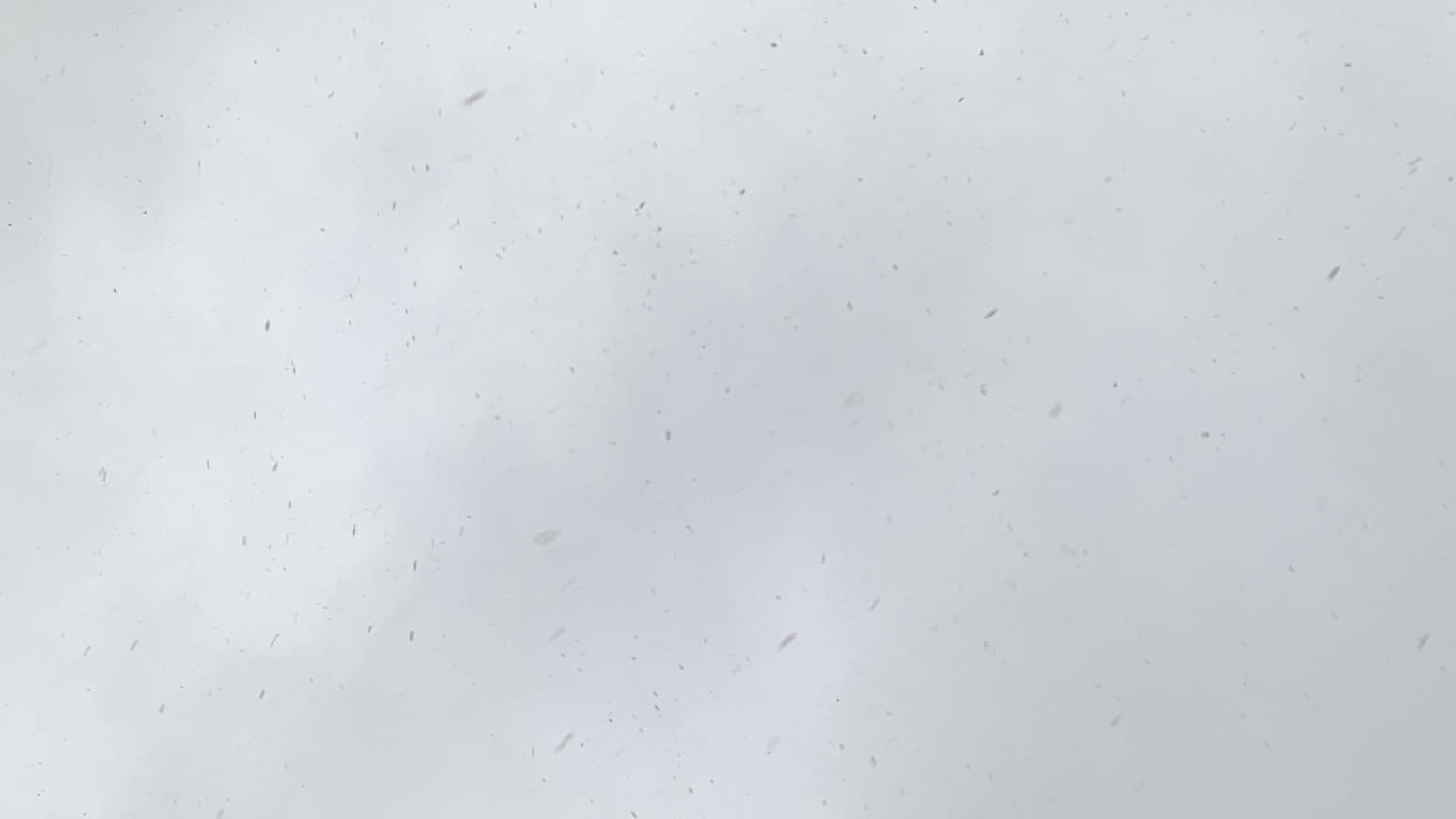
New York City, February 22, 2026
★★★★ The gray and dripping morning looked ordinary but then came fat snowflakes, one by one, as isolated as individual scraps of debris. A few minutes more and the flakes were fine and numerous. Sparrows foraged on the sidewalk like little mobile lumps of the brown-gray wet concrete. The flakes abated and then returned, now in multiple sizes and blowing in multiple directions. Roadways and sidewalks remained merely wet all through the morning and into afternoon, even as the weather app claimed there had been more than an inch of accumulation. The dirty snowpile on the corner whitened again and snow stuck to branches but people trudged along through the wet in regular shoes. A sideways turn of the wind stuck a star field of assorted clumpy flakes to the window screen. In the last hour of daylight, the white finally began sticking in thin patches to the sidewalk, and then the night was filled with light bouncing between the clouds and the suddenly thick blanket of snow, as bright as the afternoon had been dark. Outside the window of the smallest bedroom, a little wall of snow had risen, not pressed against the screen but standing unbraced along the length of the outer sill.

New York City, February 23, 2026
★★★★★ The snowflakes were dense and fine and blowing fast. Snow gathering through the night had more than doubled the thickness of the railings and bulged down over the top of the living-room window, with curved claws of icicles extending from the mass. With the roads officially closed to traffic, pedestrians labored up the middle of the avenue. The dogwood branches were sagging under fluff out back; on the honeylocust out front, snow clung to the upwind side of the branches leaning downwind and to the downwind side of the branches leaning upwind. The storm kept going through lunch, then dwindled and stopped. The app said it was 34 degrees out, and huge chunks of snow were falling from the trees and buildings. Plows had left Central Park West open and sloppy with slush. The snow deep, lofty, and wet, perfect for packing. Someone had built an entire igloo on the lawn inside the Park, without even needing to form the snow into blocks. A folded umbrella lay inside its entrance tunnel. Snowmen stood five feet tall easily; forts had been raised chest- or shoulder-high; no matter what anyone had done to move the snow around, the ground remained covered everywhere in white. The snow went over the boot tops and pressed against the shins and squeezed into hard wads where it got caught inside the boots. The slopes were slick and fast enough to send a sled airborne on the bumps. Runaway saucers or toboggans skidded onward after losing or being lost by their riders. Children flung themselves at the hills on their bellies, borne along on the dense snowpack. Shattered sled plastic in at least two different greens and a blue lay in and around a trashcan. The sun made a bright spot on the gray of the clouds until a heavier gray, spreading from the west, covered it up.
New York City, February 24, 2026
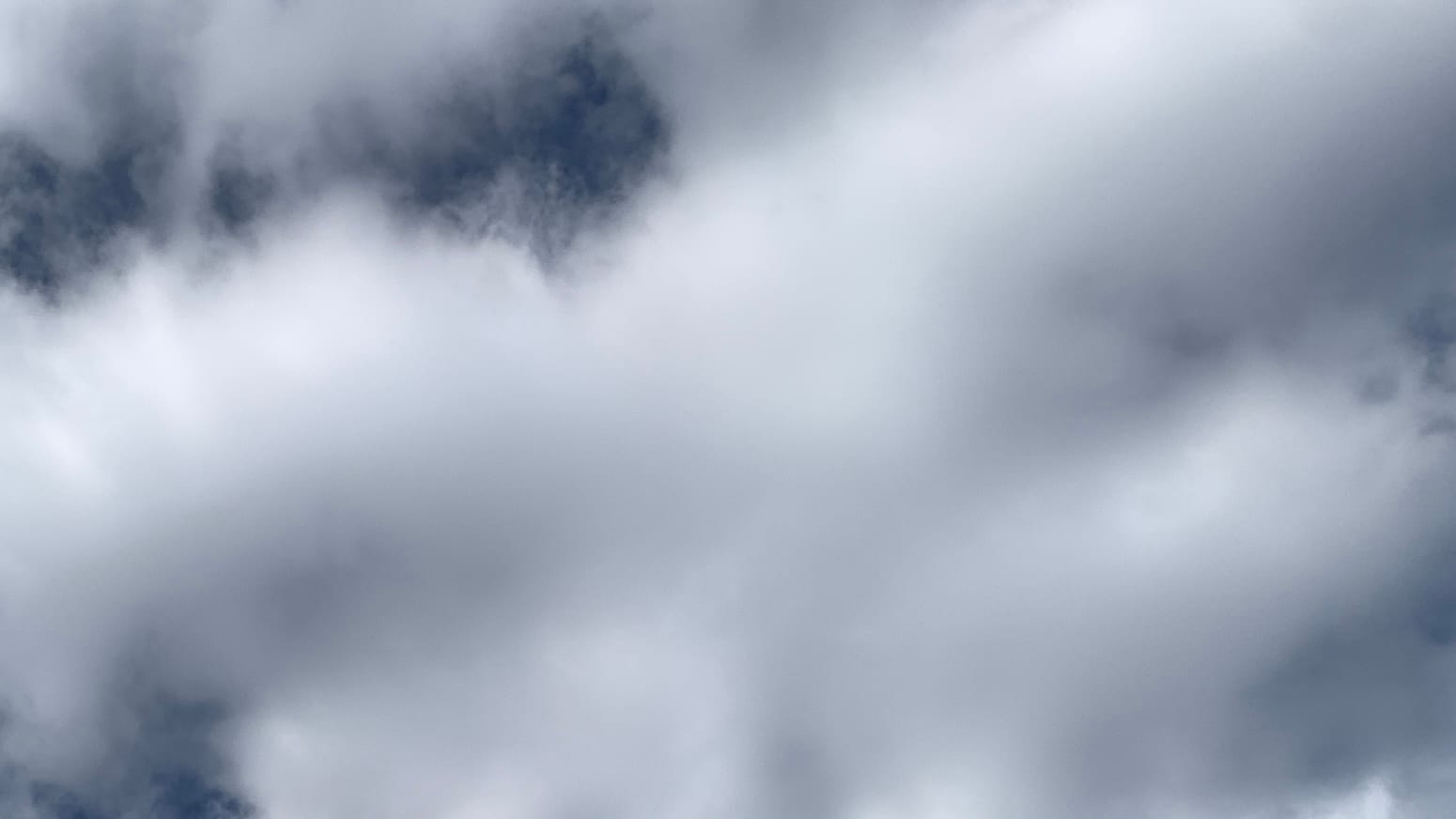
★★★★ The mounds of snow on the cars were lumpy and ragged with the impacts of snow clumps dropping onto them from the trees. An otherwise clean and shoveled-out SUV had one long pile on its passenger-side roof, either mysteriously left unswept or prodigiously dumped from a branch. The snow was still predominantly brilliant white. Passengers got off the subway carrying toboggans under their arms. The sun went away very slowly from a clear blue sky above a shaded street, out the window of an overheated room. In the night, the snow on the rock face of the Park presented a smooth, even white cross section along the contours of the outcroppings. A half-moon was right overhead and again the stars were sharp and bright.

New York City, February 25, 2026
★★★★ The white outside the windows was suddenly in unexpected places: fully tracing the branches that had been mostly shaken clear, carpeting the dug-out cars and the freshly plowed roadway—and more was falling, blowing south to north this time, as what was forecast to be a brief trace of snow arrived as a thick and genuine snow shower. Despite its strong debut, though, the sun arrived to clear it out, and the gurgle of melting returned. The afternoon breeze was mild enough to conjure spring, even with slush underfoot and snowfields all around. The snow lay smooth on the ice of the Pool, where no trees could reach to shed chunks of loosened snow onto it or pock it with dripping water. The upthrust knotted tips of various-colored bags of dog waste, sticking out the mouth of a trash barrel awaiting collection, glowed like stained glass with the late sun. Boot heels bit into the softened surface underfoot. Fallen caution tape drooped beside a barrier meant to close the way to a now well-cleared stairway. The melt in the night sounded like a steady rain.

EASY LISTENING DEP'T.
Here is the Indignity Morning Podcast archive!
 TOM SCOCCA

SANDWICH RECIPES DEP'T.
WE PRESENT INSTRUCTIONS for the assembly of sandwiches selected from Child's Recipes for Cooking and Preparing, by Childs Company, published in 1913 and available at archive.org for the delectation of all.
SANDWICHES
In preparing bread for sandwiches a loaf weighing 22 ounces should be cut into 32 slices.
CHICKEN.
Butter two pieces bread, place between them 3/4 ounce of sliced chicken. Trim edges of sandwich and wrap in wax paper.
CLUB.
3 pieces fresh toast
1 1/2 oz. sliced chicken
4 pieces fried bacon
1 1/1 teaspoonfuls Mayonnaise dressing
2 lettuce leaves
salt and pepper
Place 1 leaf of lettuce on a piece of toast and spread with Mayonnaise dressing. Cover lettuce with sliced chicken and 2 pieces of bacon. Prepare another piece of toast same as above with a third piece of toast placed on top. Cut diagonally across.
CORNED BEEF.
Butter two pieces of bread, place between them 3/4 ounce of boiled corned beef. Trim edges of sandwich and wrap in wax paper.
If you are inspired to prepare a sandwich inspired by these offerings, be sure to send your thoughts and a picture to indignity@indignity.net.

SELF-SERVING SELF-PROMOTION DEP'T.